

Please use this form to send us a message, or feel free to call us directly.
Sparrows CapitalOffice 7, 35-37 Ludgate Hill
London EC4M 7JN
At Sparrows Capital, we believe in clarity, discipline, and data-driven decision-making. Our evidence-based investment approach is built for the long term—no market timing, no speculation, but rather a systematic strategy grounded in over a century of market data and rigorous academic research.
Smart investing isn’t about predicting the future—it’s about building on what the evidence tells us works. That’s the Sparrows Capital way.



Efficient & Cost-Effective – We focus on delivering market returns without unnecessary costs.
Diversified & Liquid – We spread risk across liquid asset classes for stability and growth.
Index-Driven – Our portfolios are built using index funds and ETFs.
Proven Expertise – With over a decade of managing our founding family’s portfolios
Guided by Research – Professor Elroy Dimson, former chair of the Norwegian Sovereign Wealth Fund’s Strategy Council, provides insights that help shape our strategy.
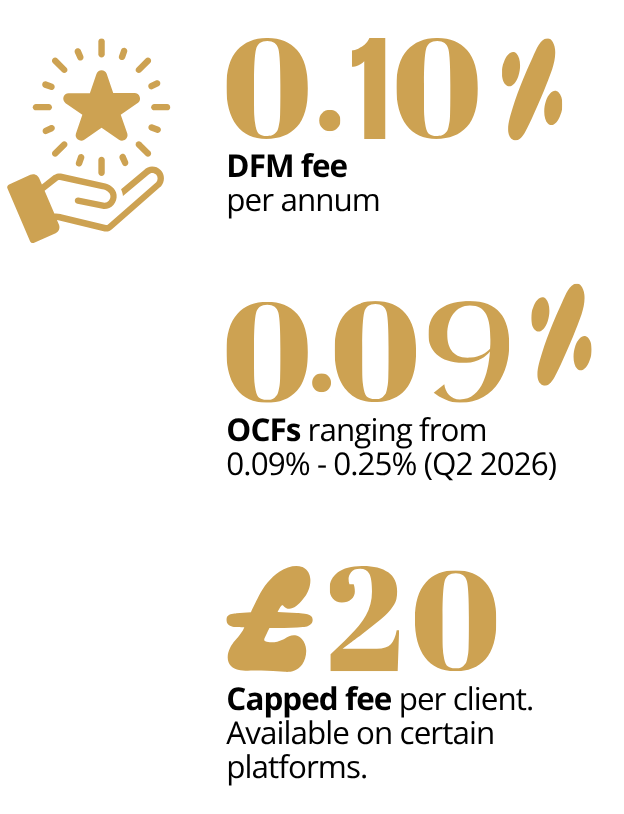
Our versatile suite of solutions is designed to deliver fair value, transparency, and strong client outcomes. We prioritise cost-effective, evidence-based strategies that align with long-term client goals while providing clear insights into fees, performance, and suitability. Our capped-fee model (available on select platforms) ensures clients receive value without unnecessary costs, and our commitment to the FCA’s Consumer Duty reinforces our focus on client-first investing.



Yariv Haim, CEO

Initial research by The Lang Cat surveyed over 600 Adviser firms:
Over 80% of respondents voiced support for the concept of a fixed/capped fee model.
The preferred price point was £20 / £30 per month.
Of those who expressed a preference, 73% favoured a capped fee model.

Sparrows SCore Market Equity 60 (Funds)

Sparrows SCore Factor Equity 60 (Hybrid)

Sparrows SCore Responsible Equity 60 (Hybrid)
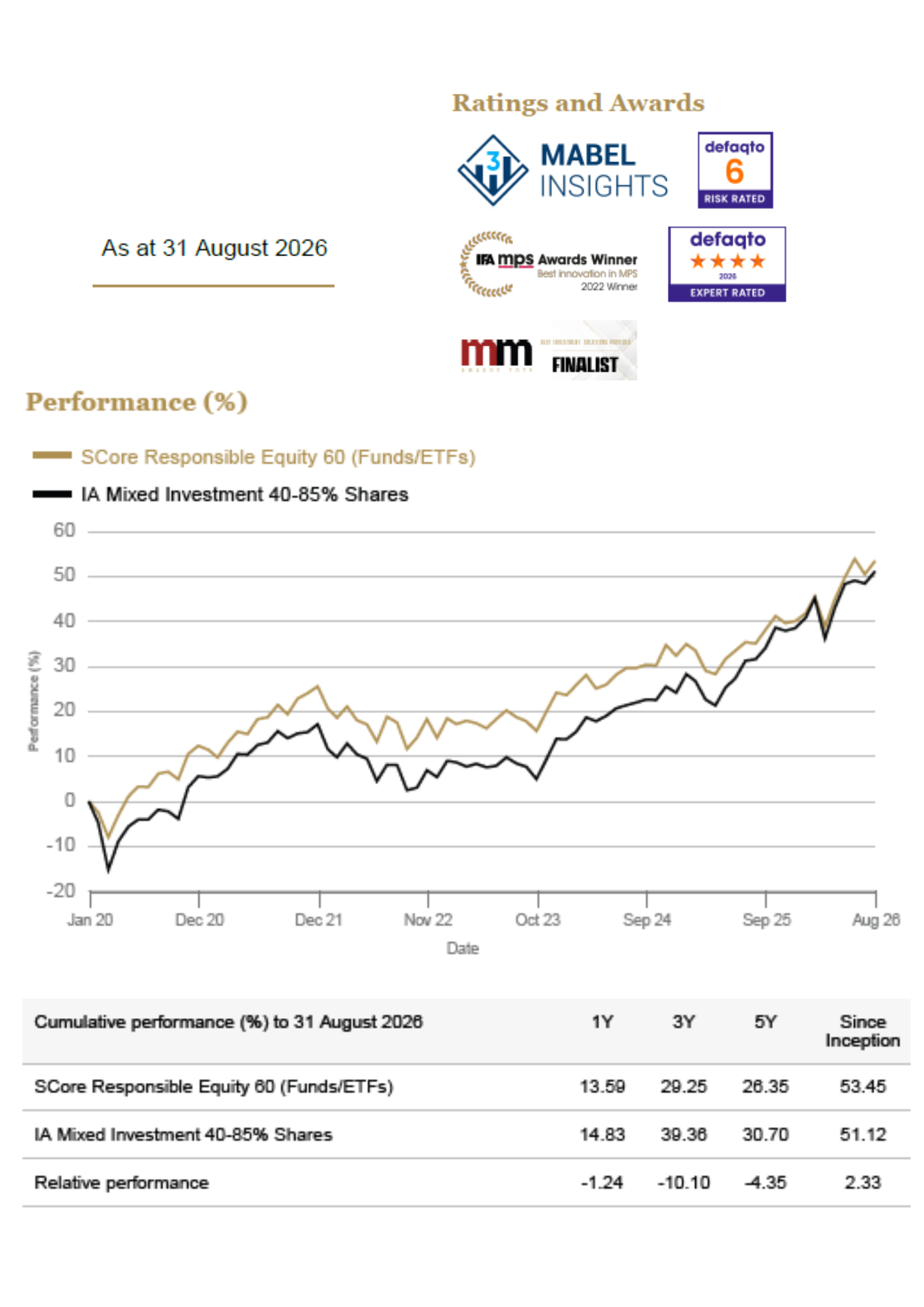
Gain insights into how our Model Portfolio Services are designed to deliver value and meet the needs of your clients through our Target Market Statement and latest Assessment of Value reporting information.
An evidence-based investment approach involves an objective, rules based approach to markets, the building blocks for which are passive ETFs and Index Funds. Many active market participants adopt a hybrid approach, and express active macro views using efficient passive instruments. In doing so, these participants are foregoing one potential source of outperformance (stock selection), and are focusing their effort on extracting alpha through market timing. This style relies on subjective decisions and manager skill, and is not a passive approach, although it is often presented and marketed as such.
Tactical asset allocation is another euphemism for a strategy which attempts to extract outperformance (alpha) through market timing, by identifying asset classes which are overbought (or oversold) and decreasing (or increasing) portfolio exposure to such asset classes. Empirical studies demonstrate that the vast majority of managers consistently fail to add value through tactical allocation, and indeed tend to destroy value through such decisions. An evidence-based strategy does not involve tactical allocation.
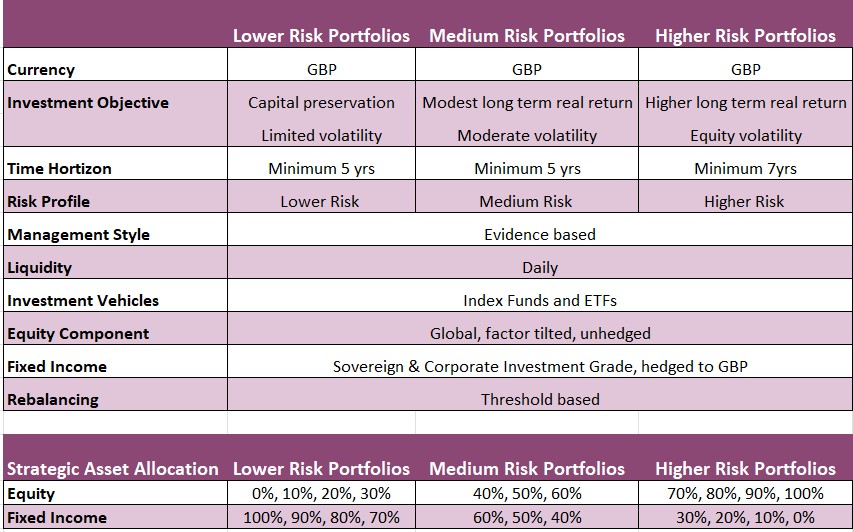
The rule-based investment universe comprises Index Funds and ETFs. Portfolio construction begins with a risk allocation process focussed on the investor. This should then be expressed as a benchmark in the form of a granular set of indices representing the relevant investable universe. The ETFs tracking the benchmark indices must then be screened for methodology, tracking error, liquidity, costs, tax efficiency, structure and counterparty risk.
If the intention is to select a single product, then an investor can indeed self-select on the basis of product sponsor and cost. But single products tend to focus on large cap companies in major market, and they fail to address the full investable universe. This approach also forgoes the potential benefit of applying factor tilts to the portfolio (see below). Employing a manager also improves discipline, facilitates consistent rebalancing, reduces an investor’s behavioural bias and reduces the tendency to make ill-timed subjective decisions.
We advocate a core / satellite approach, with the core portfolio invested using evidence-based techniques with a view to harvesting market returns (beta) as efficiently as possible. This can be complemented by a number of specialist satellite products / strategies intended to capture alpha or to access other risk premia (examples might be private equity or real estate holdings). It is important that the investor fully understand why and how each satellite strategy will add value, and that their performance is rigorously reassessed on a regular basis.
The primary purpose of rebalancing is to ensure consistency of portfolio risk. As with all aspects of a passive strategy, rebalancing must be carried out objectively in accordance with predefined rules. Much work has been done to identify optimal rebalancing frequencies, thresholds and timing, but ultimately the most important component of a rebalancing process is discipline.
Academic studies have revealed that certain sub-sections of the market have persistently experienced higher returns than the broader market. Recognised factors include small size, value, low volatility and momentum. Factor investing tilts the portfolio, again using a rules-based approach, towards these rewarded risk factors. The resulting strategy remains focused on harvesting market returns (beta), but the components of the market are weighted toward persistently rewarded factors (selective beta).
Modern portfolio theory relies on a multi-asset class approach to ensure multi-layered diversification. We advocate liquid, global, multi-asset portfolios comprising Index Funds and ETFs which, in turn, ensure maximum diversification within each investment layer.
The emergence of highly efficient rule-based investments is forcing active managers to up their game substantially. Managers with low active share (including closet indexers) are being forced to lower fees and increase efficiency; we are seeing related merger activity as this industry looks to consolidate and achieve economies of scale and scope. Smaller active managers will be forced to increase active share and focus on genuine consistent alpha production in order to justify fees and remain viable. We expect the industry to be smaller and more competitive in the future.
Rule-based investing has been practiced since the 1970s and has stood the test of the global financial crisis. By definition, an investment designed to replicate the market return will efficiently track markets downwards as well as upwards, but the important question is whether this outcome will be better or worse than that of a managed investment in the same conditions. Our analysis shows that managers succumb to the same behavioural biases which are known to damage the performance of individual investors in turbulent markets, and that attempts to protect a portfolio from volatility tend to significantly destroy value across the cycle.
Important Information
Material on this site is issued in the United Kingdom (“UK”) by Sparrows Capital Limited (“Sparrows”) which is authorised and regulated in the UK by the Financial Conduct Authority (“FCA”).
Use of Information and Material
The information contained on this site (including any expression of opinion or forecast) has been obtained from, or is based on, sources believed by Sparrows and its associated companies to be reliable, but is not guaranteed as to its accuracy or completeness. This does not exclude or restrict any duty or liability that Sparrows has to its customers under the regulatory system in the United Kingdom. This Site and the information herein is for general information purposes only. Your eligibility for particular products and advisory or management services is subject to local law and regulation.
Risk Factors
Past performance is no indication of future performance. The value of investments may fall as well as rise and investors may not get back the full amount invested. Changes in rates of foreign exchange may cause the value of investments to go up or down.
No Advice, Offers or Solicitations
The information and materials in this Site should not be construed as providing tax, legal or investment advice. In addition, they do not constitute an offer or solicitation, or an offer to sell, shares of any funds or any advisory or management service.. The type of securities mentioned may not be suitable for everyone.
USERS ARE URGED TO BASE THEIR INVESTMENT DECISIONS UPON A THOROUGH INVESTIGATION AND TO OBTAIN ALL NECESSARY PROFESSIONAL ADVICE.
Material Interests
Staff and/or directors of Sparrows may have holdings in the investment funds referred to on this site.
United Kingdom Stewardship Code
The Stewardship Code (the “Code”) was developed from the Walker Review on Corporate Governance in the UK and aims to enhance the quality of engagement between investors (and investment managers) and UK listed companies.
Sparrows supports the principles enshrined in the Code. Although the Code is voluntary, the FCA requires Sparrows to include on this website a disclosure about its commitment to the Code or, where it does not so commit, its alternative strategy. The FCA and the Financial Reporting Council have acknowledged that certain aspects of the Code are not directly relevant to all investment firms.
Sparrows invests almost exclusively in rule-based ETFs and index funds in order to capture market returns across all asset classes globally. Sparrows does not directly invest in shares or bonds issued by UK listed companies and therefore has no direct interaction with the management of such companies and does not enjoy voting rights in relation to such companies. For this reason, the Code is not directly relevant to Sparrows and it is not practical for Sparrows to implement a policy of direct engagement.
Sparrows’ due diligence prior to investing in an ETF or index fund does, however, take specific account of the fund manager’s own commitment to the Code (or equivalent depending on jurisdiction) and the nature of their engagement and voting policies with regard to companies in which their funds invest.
Given both Sparrows’ and the ETF or index fund provider’s index tracking requirements, there is very limited scope for stewardship through selective allocation or de-allocation decisions. For this reason, Sparrows’ analysis focuses on stewardship through engagement and through the exercise of voting rights.
Copyright, Trademarks and Other Rights
Copyright and trademarks and all similar rights in this site are owned by Sparrows, or relevant third-party content providers. You may use the information on this site and reproduce it in hard copy for your personal reference only. Such information may not otherwise be reproduced, distributed, stored in a data retrieval system or transmitted, in any form or by any means – electronic, mechanical, photocopying, recording or otherwise – without the prior written permission of Sparrows.
Complaints
Any complaints about the Sparrows service or website should be directed to:
The Compliance Officer, Sparrows Capital Limited, Office 7, 35-37 Ludgate Hill, London, EC4M 7JN
If we are unable to resolve the matter to your satisfaction, you may have access to the Financial Ombudsman Service. The Financial Ombudsman Service’s website is at http://www.financial-ombudsman.org.uk/
Background
These are the Pillar 3 disclosures made by Sparrows Capital Limited (“Sparrows”) in accordance with the UK Financial Conduct Authority’s (“FCA”) Prudential Sourcebook for Banks, Building Societies and Investment Firms (“BIPRU”).
The European Union Capital Requirements Directive (“CRD”) created a regulatory capital framework consisting of three ‘pillars’ namely:
Pillar 1 – sets out the minimum capital requirements that firms are required to meet;
Pillar 2 – requires firms to take a view on whether additional capital should be held against capital risks not covered by Pillar 1; and
Pillar 3 – requires firms to publish certain details of their risks, capital and risk management process.
Disclosure policy
The rules in BIPRU 11 provide that Sparrows may omit one or more of the required disclosures if it believes that the information is immaterial. Materiality is based on the criteria that the omission or misstatement of material information would be likely to change or influence the assessment or decision of a user relying on that information for the purposes of making economic decisions. Where Sparrows considers a disclosure to be immaterial, this will be stated in the relevant section.
Sparrows is also permitted to omit one or more of the required disclosures where it believes that the information is regarded as proprietary or confidential. Proprietary information is that which, if it were shared, would undermine Sparrows’ competitive position. Information is considered to be confidential where there are obligations binding Sparrows to confidentiality with its clients and counterparties.
Where Sparrows has omitted information for any of the above reasons, a statement explaining this will be provided in the relevant section.
Unless stated as otherwise, all figures contained in this disclosure are based on Sparrows’ audited annual reports for the year ending 31 December 2025.
Frequency
These Pillar 3 disclosures will be reviewed on an annual basis as a minimum. The disclosures will be published as soon as is practical following the finalisation of Sparrows’ Internal Capital Adequacy and Risk Assessment (“ICARA”) and its annual accounts.
Verification
The information contained in these disclosures has not been audited by Sparrows’ external auditors and does not constitute any form of financial statement.
Publication
Sparrows’ Pillar 3 disclosures are published on its website.
Scope and application of CRD requirements
These disclosures are made in respect of Sparrows, a BIPRU firm authorised and regulated by the FCA, providing financial advice and discretionary investment management services.
Risk management objectives and policies
Sparrows’ risk management policy reflects the FCA requirement that it must manage a number of different categories of risk. These include: liquidity; credit; interest rate; market; and operational risks.
Sparrows manages all cash and borrowing requirements to maximise potential interest income whilst ensuring it has sufficient liquid resources to meet the continued operating needs of its business. This is supported by a robust budgeting and forecasting process which has the full involvement of the senior management team.
The main credit risk for Sparrows relates to income from fees, the risk being that a client does not pay amounts due for services provided by Sparrows. In most cases, quarterly management fees are charged to clients based on a percentage of the client’s assets under management. Concentration risk is defined as the risk of loss of income through external changes having a disproportionate impact on overall income due to a reliance on revenue from certain sectoral, geographic areas and/or businesses. Credit risk concentrations include significant exposure to an individual client or group of clients and credit exposures to clients in the same economic sector or geographic region.
A significant proportion of Sparrows’ income is received from clients that are part of the same group as Sparrows’ major shareholders. This ongoing interest in the activities of Sparrows by the group mitigates the risk of the group jeopardising Sparrows’ income flow.
Sparrows is exposed to country risk as a number of clients are based in a non-European Economic Area country. As these clients are all high net worth or ultra-high net worth long-term investors with spare capital invested in globally diversified liquid financial instruments, the risk of being unable to meet unforeseen financial needs and payment of Sparrows’ fees is low.
Based on the analysis of concentration risk, the risk of non-payment of fees has been assessed as minimal.
Sparrows has no exposure to interest rate risk as it has no debt and no client cash deposits.
The main market risk for Sparrows relates to falls in value of assets under management following a market downturn, which would lead to lower management fees. To mitigate its market risk, Sparrows regularly analyses various different economic scenarios to model the impact of economic downturns on its financial position.
Operational risk is defined as the potential risk of financial loss or impairment to reputation resulting from inadequate or failed internal processes and systems, from the actions of people or from external events.
Major sources of potential operational risk include: Outsourcing of operations, IT security, internal and external fraud, implementation of strategic change and regulatory non-compliance.
Sparrows operates a robust risk management process which is regularly reviewed and updated by its Board. The Board formally reviews all significant risk issues at least annually as part of the ICARA.
All senior members of staff bear responsibility for internal controls and the management of business risk as part of their accountability to the Board. All staff are responsible for identifying the risks surrounding their work, implementing controls over those risks and reporting areas of concern to their senior member of staff.
Sparrows operates a simple business model. Accordingly, many of the specific risks identified by the FCA do not apply. For example, it has no material outsourcing arrangements and does not hold any client assets.
Capital resources
Pillar 1 requirement
In accordance with the FCA rule GENPRU 2.1.45R (calculation of variable capital requirement for a BIPRU firm), Sparrows’ capital requirement has been determined as being its fixed overhead requirement and not the sum of its credit risk capital requirement and its market risk capital requirement.
The Pillar 1 capital requirement for Sparrows was £688,000 as at 31 December 2025.
Pillar 2 requirement
Sparrows’ overall approach to assessing the adequacy of its internal capital is set out in its ICARA report. The ICARA involves separate consideration of risks to Sparrows’ capital, combined with stress testing using scenario analysis. The level of capital required to cover risks is a function of impact and probability. Sparrows assesses impact by modelling the changes in its income and expenses caused by various potential risks over a 1-year time horizon. Probability is assessed subjectively. In addition, Sparrows has reviewed the outputs of its risk reviews to quantify any risks identified. This has identified a number of key business risks, which (having reviewed the guidance in BIPRU 2.2.61-65) Sparrows has classified against the risk categories outlined in FCA rule GENPRU 1.2.30R.
Sparrows Pillar 2 capital requirement, which is its own assessment of the minimum amount of capital that it believe is adequate against the risks identified, has been assessed as greater than its Pillar 1 requirement.
There is a considerable surplus of reserves above the capital resource requirement deemed necessary to cover the risks identified.
Regulatory capital
The main features of Sparrows’ capital resources for regulatory purposes, as at 31 December 2025 are as follows:
| Capital item: | £000 |
| Tier 1 capital (called up share capital, share premium account, profit and loss account, externally verified interim net profits) | 1,157 |
| Total of Tier 2 and Tier 3 capital (broadly long and short term subordinated loans) | – |
| Deductions from Tier 1 and Tier 2 capital | – |
| Total capital resources, net of deductions | 1,157
|
Sparrows holds regulatory capital in accordance with the CRD. All such capital is classified as Tier 1 capital and is therefore of the highest quality.
Remuneration Code Disclosures
Sparrows is subject to the BIPRU Remuneration Code. This section provides further information on Sparrows’ remuneration policy.
BIPRU Remuneration Code Staff
Sparrows has identified, and maintains a record of, BIPRU Remuneration Code staff (“Code staff”), i.e. staff to whom the BIPRU Remuneration Code applies. This includes senior management and members of staff whose actions may have a material impact on Sparrows’ risk profile. All of Sparrows’ Code staff fall into the “senior management” category of Code staff (rather than the “risk taker” category) for the purposes of the BIPRU Remuneration Code.
Decision Making / Remuneration Committee
Sparrows does not have and is not required to have a Remuneration Committee. The Board is responsible for Sparrows’ remuneration policy including determining the framework and policy for remuneration and ensuring it does not encourage undue risk taking; agreeing any major changes in remuneration structures; reviewing the terms and conditions of any new incentive schemes and in particular, considering the appropriate targets for any performance related remuneration schemes; and considering and recommending the remuneration policy for senior staff taking into account the appropriate mix of salary, discretionary bonus and share based remuneration.
In determining remuneration arrangements, the Board will give due regard to best practice and any relevant legal or regulatory requirements including the BIPRU Remuneration Code.
Link between pay & performance
There is ostensibly a discretionary variable pay element to the Sparrows’ remuneration package.
Quantitative information on remuneration
The FCA rules require certain firms to disclose aggregate information on remuneration in respect of its BIPRU Remuneration Code staff broken down by business area, senior management and other Code staff, including “risk takers”.
Sparrows has only one business area – investment management & advice.
Sparrows has 4 Directors but no material “risk takers”. Director remuneration is agreed formally at Board meetings. The link between performance and pay is inevitable in a small firm, but Sparrows’ risk-averse strategy and robust risk management systems mitigate risks.
At Sparrows Capital we are committed to safeguarding and preserving the privacy of our visitors. This Privacy Policy explains what happens to any personal data that you provide to us, or that we collect from you whilst you visit our site.
We do update this Policy from time to time so please do review this Policy regularly.
In running and maintaining our website we may collect and process the following data about you:
Cookies provide information regarding the computer used by a visitor. We may use cookies where appropriate to gather information about your computer in order to assist us in improving our website.
We may gather information about your general internet use by using the cookies. Where used, these cookies are downloaded to your computer and stored on the computer’s hard drive. Such information will not identify you personally. It is statistical data. This statistical data does not identify any personal details whatsoever.
You can adjust the settings on your computer to decline any cookies if you wish. This can easily be done by activating the reject cookies setting on your computer.
We use the information that we collect from you to provide our services to you. In addition to this we may use the information to provide information to you that you request from us relating to our services and to inform you of any changes to our website or services.
In operating our website it may become necessary to transfer data that we collect from you to locations outside of the European Union for processing and storing. By providing your personal data to us, you agree to this transfer, storing or processing. We do our upmost to ensure that all reasonable steps are taken to make sure that your data is treated and stored securely.
Unfortunately the sending of information via the internet is not totally secure and on occasion such information can be intercepted. We cannot guarantee the security of data that you choose to send us electronically. Sending such information is entirely at your own risk.
We will not disclose your personal information to any other party other than in accordance with this Privacy Policy and in the circumstances detailed below:
On occasion we include links to third parties on this website. Where we provide a link it does not mean that we endorse or approve that site’s policy towards visitor privacy. You should review their privacy policy before sending them any personal data.
In accordance with the General Data Protection Regulation (GDPR) you have the right to access any information that we hold relating to you. Please note that a reasonable charge may be payable.
Cross-Device Tracking and Ad Targeting
We may engage in cross-device tracking and ad targeting to provide you with personalised advertising experiences across your devices. This means that we may collect information about your activities on our website and other online platforms, as well as on your various devices such as your computer, smartphone, or tablet. The information collected may include but is not limited to, your browsing history, interactions with advertisements, and device identifiers.
The purpose of cross-device tracking and ad targeting is to tailor advertisements to your interests and preferences, making them more relevant to you. This helps us to deliver a more personalised and engaging experience while also allowing us to measure the effectiveness of our advertising campaigns.
We may work with third-party advertising partners and service providers who assist us in delivering targeted advertisements. These partners may use cookies, web beacons, and other tracking technologies to collect information about your activities across different websites and devices to provide you with targeted advertisements.
You can opt-out of targeted advertising by adjusting your device settings or by using opt-out tools provided by third-party advertisers and ad networks. Please note that opting out of targeted advertising does not mean you will no longer see advertisements, but rather that the advertisements you see may be less relevant to your interests.
By continuing to use our website and services, you consent to the use of cross-device tracking and ad targeting as described in this Privacy Policy.
Please do not hesitate to contact us regarding any matter relating to this Privacy Policy at info@sparrowscapital.com.